
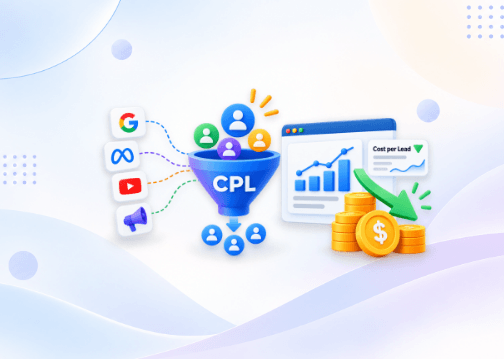
CPL for Publishers: Formula, Model, and Ways to Lower Your Costs
What Is CPL (Cost Per Lead)?
You’ve probably heard the term CPL if you follow performance marketing. CPL stands for Cost Per Lead. An advertiser pays this amount for every qualifying lead. A lead might be a form fill. It might be a newsletter sign-up. It might be a quote request.
CPC works differently. With CPC, advertisers pay per click, no matter what happens next. CPL only charges advertisers for a real action. That makes it one of the more advertiser-friendly pricing models. Advertisers pay for actual business value, not just traffic.
CPL campaigns can bring in strong revenue for publishers. This works especially well in finance, insurance, education, and health niches. A single qualified lead often earns more than a simple ad click.
CPL Formula: How to Calculate CPL and Example
The CPL formula is simple.
CPL = Total Marketing Campaign Cost ÷ Number of Leads Generated
Here’s a quick example. An advertiser spends $1,000 on a lead gen campaign in one month. That campaign brings in 200 leads. The math looks like this: $1,000 ÷ 200 = $5 per lead
Each completed form costs the advertiser $5. If you earn on a CPL basis, you take a share of that $5. The split depends on your network or campaign agreement.
This formula works in reverse too. Say an advertiser wants a $5 CPL and needs 500 leads. They’d budget $2,500 for the campaign upfront.
What Is a CPL Model?
A CPL model is the pricing structure behind a campaign. Advertisers don’t pay per impression or per click here. Instead, they pay a fixed amount for each completed lead.
CPL models usually come in two types:
- Flat CPL: Both sides agree on one price per lead. This price stays the same as long as the lead meets basic criteria, like a valid email or phone number.
- Tiered or performance-based CPL: The payout shifts depending on lead quality, source, or region. A lead from a high-intent landing page often pays more than one from a generic pop-up.
Publishers typically use lead-gen forms, quizzes, surveys, or sign-up widgets. You place these directly on your site. The network pays you once a visitor completes the action.
SOI Ads vs DOI Ads
CPL campaigns usually involve one of two lead types: SOI or DOI.
SOI (Single Opt-In)
SOI counts a lead the moment someone submits their information. There’s no extra confirmation step. This makes the process faster and easier for visitors. It usually means higher lead volume too.
But SOI has a tradeoff: lead quality. Without a verification step, some leads include typos or fake details. Some visitors might click through without real interest.
DOI (Double Opt-In)
DOI requires one extra step. The lead has to confirm their submission a second time. They usually click a link in a confirmation email. This step filters out low-intent or invalid entries. The result is a smaller but higher-quality lead pool.
Advertisers in regulated fields, like finance or healthcare, often prefer DOI. These leads hold up better for compliance. They also tend to convert at higher rates later in the funnel.
DOI campaigns usually pay a higher CPL than SOI campaigns. The leads simply carry more value. But total lead volume tends to run lower here. Not everyone finishes the confirmation step.
Why Is CPL Important?
CPL measures how efficiently a campaign turns ad spend into real results. It goes beyond just clicks or impressions.
Here’s why that matters for both sides:
- For advertisers, CPL shows exactly what it costs to acquire a customer. This makes budgeting and ROI calculations much clearer.
- For publishers, CPL helps you judge if a lead gen campaign is worth the ad space. You can compare it directly against a CPC or CPM ad in the same slot.
- For both sides, CPL creates alignment. Advertisers only pay for real leads. Publishers who deliver quality traffic earn better rates over time.
A high CPL isn’t automatically a problem, especially in high-value industries. But tracking it consistently helps you spot underperforming campaigns or traffic sources.
Tips to Reduce CPL
A few practical steps can help lower CPL, whether you’re an advertiser or a publisher.
- Improve landing page relevance. Match your landing page to what the ad promised. This alone can improve conversions and cut wasted spend.
- Target more specific audiences. Broad targeting brings cheap clicks but often low intent. Narrower targeting costs more per click but usually converts better.
- Simplify the form. Every extra field gives visitors a reason to leave. Ask only for what you truly need.
- Test SOI and DOI separately. One opt-in type may work better for your industry. Testing both tells you which one performs.
- Optimize for mobile. Most lead gen traffic now comes from phones. A clunky mobile form kills conversions fast.
- Use retargeting. Visitors who didn’t convert the first time often cost less to bring back. New traffic almost always costs more.
CPL Advantages Vs Disadvantage for Publishers
CPL comes with real tradeoffs. Weigh them before committing significant ad space.
Advantages:
- Often pays more per action than standard CPC or CPM ads.
- Works well with content that centers on lead capture, like quizzes or comparison sites.
- Adds a new revenue stream beyond standard display ads.
Disadvantages:
- Lead approval can be strict. Disputed leads mean lost revenue, even after a visitor completes the action.
- Conversion rates vary a lot by niche. CPL isn’t equally profitable everywhere.
- Setup takes more work than standard display ads. You need forms, tracking, and sometimes compliance steps in place.
- Payouts can take longer. Leads go through validation before the network pays you.
CPL can outperform display ads by a wide margin, for the right audience. For others, it may just add complexity without much payoff.
Final Thoughts
CPL looks simple on paper, but it has real depth in practice. Learning the formula matters. Understanding SOI versus DOI matters too. So does knowing where CPL fits into your overall monetization mix.
CPL won’t suit every website. But if your niche fits, it’s worth testing. Run it alongside your existing ad setup and see what it adds.
FAQs
What does CPL mean in advertising? CPL stands for Cost Per Lead. Advertisers pay for each completed lead action, like a form or sign-up. They don’t pay for clicks or impressions here.
How is CPL different from CPA? CPL pays for a lead, like a form fill. CPA (Cost Per Acquisition) only pays once that lead makes a full purchase. CPA is stricter, and it usually pays more per action.
Is a lower CPL always better? Not necessarily. A very low CPL can mean lower-quality leads. Those leads often don’t convert further down the funnel. Look at CPL alongside lead quality and conversion rate together.
Which is better for publishers, SOI or DOI? It depends on your advertiser and niche. SOI brings higher volume at a lower payout. DOI brings fewer leads, but they pay more and convert better. Test both to see what fits your traffic.
Can any website run CPL campaigns? Technically, yes. But CPL works best on sites that focus on lead capture. Finance, insurance, education, and review sites usually see the strongest results.