
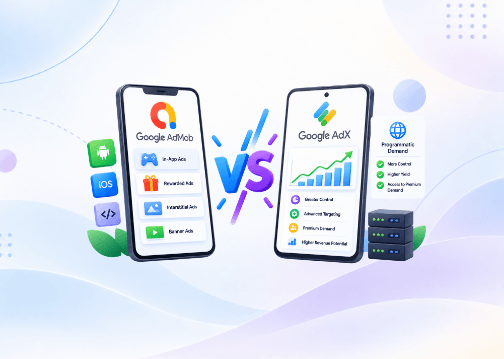
AdMob vs AdX: A Comparison for App Publishers
App publishers usually run into the same question early on. Should you monetize with AdMob or Google AdX? Both platforms come from Google. Both help you earn money from ad space. But they work very differently under the hood.
This guide breaks down what each platform does. It also covers the key differences, and which one fits your app better.
What Is Google AdMob?
Google AdMob is Google’s mobile ad network. It’s built specifically for apps, not websites. Publishers use it to show ads inside iOS and Android apps.
AdMob works as a self-serve platform. You sign up, add the SDK to your app, and start showing ads within minutes. It’s designed for simplicity. Most small and mid-sized app developers start here.
AdMob also connects to Google’s massive advertiser demand. This means your ad inventory gets bids from a large pool of buyers automatically.
Key Features
- Multiple ad formats. AdMob supports banner ads, interstitials, rewarded video, native ads, and app open ads.
- Built-in mediation. AdMob can pull in bids from other ad networks too, not just Google’s own demand.
- Easy setup. The SDK integration is beginner-friendly, with clear documentation and quick implementation.
- Free to use. AdMob doesn’t charge publishers upfront. Google takes a share of ad revenue instead.
- Analytics dashboard. You get built-in reporting on impressions, revenue, and fill rates without extra tools.
What Is Google AdX?
Google Ad Exchange, known as AdX, works differently. It’s a premium ad exchange built for larger publishers with significant traffic. AdX gives you access to real-time bidding from top-tier advertisers and agencies.
Unlike AdMob, AdX isn’t self-serve. You typically need to apply, and Google reviews your traffic and content before approving access. It’s usually paired with Google Ad Manager for full inventory control.
AdX tends to bring in higher-value demand. That’s because it connects publishers directly to premium buyers through real-time auctions.
Key Features
- Real-time bidding (RTB). Advertisers compete for your inventory in live auctions, often pushing eCPMs higher.
- Premium demand access. AdX connects you to large ad agencies and enterprise-level advertisers.
- Advanced inventory control. Through Ad Manager, you can set floor prices, manage deals, and prioritize buyers.
- Header bidding support. AdX works well with header bidding setups, increasing competition for your ad space.
- Higher entry requirements. Approval usually requires strong, consistent traffic and clean content.
Comparison Between Google AdMob vs Google AdX
| Factor | AdMob | AdX |
|---|---|---|
| Best for | Small to mid-sized apps | Large publishers with high traffic |
| Access | Self-serve, instant signup | Requires application and approval |
| Ad formats | Banner, interstitial, rewarded, native Ad formats |
Display, video, native, through Ad Manager |
| Demand source | Google’s ad network | Real-time bidding from premium buyers |
| Setup complexity | Simple SDK integration | Requires Ad Manager setup |
| Revenue potential | Solid for smaller scale | Higher for large, quality traffic |
| Control over pricing | Limited | Full control over floor prices and deals |
Why Choose AdMob
AdMob makes sense if you’re just starting out. It doesn’t require approval, so you can start earning right away. The setup process takes very little time.
It also works well for smaller apps. You don’t need massive traffic to see results. AdMob’s mediation feature helps you pull in extra demand automatically. This means you don’t have to manage multiple SDKs on your own.
If you want a simple, low-maintenance monetization setup, AdMob fits that need well.
Why Choose AdX
AdX makes more sense once your app has scale. Large publishers with steady traffic benefit most from AdX’s premium demand. Real-time bidding tends to push your eCPMs higher over time.
AdX also gives you far more control. You can set floor prices, manage direct deals, and run header bidding alongside programmatic demand. This flexibility matters a lot once your traffic hits a meaningful volume.
If you already have strong, consistent traffic, AdX likely offers better returns than AdMob alone.
Which One Is Better for Publishers?
There’s no single winner here. The right answer depends on your traffic and stage of growth.
Smaller and newer publishers usually do better with AdMob. It requires no approval process. It also pays out reliably at lower traffic volumes. Most publishers can’t meet AdX’s traffic requirements yet anyway.
Larger publishers with steady, high-quality traffic usually do better with AdX. Real-time bidding brings in stronger demand. Advanced controls let you manage pricing and deals directly. The extra setup work pays off once your scale justifies it.
A simple way to decide: start with AdMob. Track your traffic and revenue over time. Once you consistently meet AdX’s approval thresholds, consider applying. Many publishers eventually run both side by side, using AdMob for smaller placements and AdX for premium inventory.
Final Thoughts
AdMob and AdX aren’t really competitors. They serve different stages of app growth. AdMob works best when you’re building your app and need a fast, simple setup. AdX works best once your app scales and you need more control and higher-value demand.
Many larger publishers actually run both together. AdMob handles smaller ad units, while AdX and Ad Manager manage premium inventory. Choosing between them comes down to where your app currently stands, not which platform is objectively “better.”
FAQs
Can I use AdMob and AdX together? Yes. Many publishers start with AdMob and add AdX or Ad Manager once traffic grows. Running both lets you capture demand at different value tiers.
Do I need Google Ad Manager to use AdX? In most cases, yes. AdX typically runs through Google Ad Manager, which gives you the tools to manage floor prices, deals, and inventory.
Is AdX only for websites, or does it work for apps too? AdX works for both websites and apps, though it’s more commonly associated with high-traffic websites. AdMob remains the more app-focused option for most developers.
Why did my AdX application get rejected? Google usually requires steady traffic and clean, policy-compliant content. Low traffic volume or content issues are the most common reasons for rejection.
Which platform pays better, AdMob or AdX? It depends on your traffic and scale. AdX often pays more per impression through real-time bidding, but only once you have significant, quality traffic. AdMob works well for smaller apps that don’t yet qualify for AdX.