
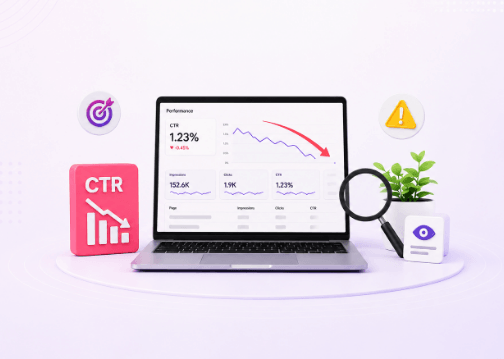
Your CTR Suddenly Dropped? Here’s What May Be Happening
You check your dashboard like you do every day, and something looks off. Impressions are steady. Traffic hasn’t changed much. But your click-through rate has taken a real hit, and you have no idea why.
This is one of the more unsettling moments in running a site or app. A CTR drop with no obvious cause feels random, but it almost never is. Something changed, whether it’s on your end, your ad partner’s end, or somewhere out in the broader ad ecosystem. The trick is knowing where to look.
This article walks through the most common reasons CTR falls off suddenly, how to tell which one applies to you, and what to actually do about it once you know.
First, Rule Out a Measurement Problem
Before you assume something is actually wrong with your ads, check whether the drop is real or just a reporting glitch. This step gets skipped more often than it should, and it can save you hours of chasing a problem that doesn’t exist.
- Check if it’s isolated to one network or tag. If CTR dropped across every ad source at once, that points to something on your site. If it’s only one partner, the issue is more likely on their end.
- Look at the timing. Did the drop start right after a code change, a new ad tag, a site redesign, or an update to your CMS or theme? That timing is rarely a coincidence.
- Compare against impressions and revenue. If impressions spiked but clicks stayed flat, your CTR will drop mathematically even though nothing is actually “broken.” That’s a different problem than an actual decline in engagement.
Once you’ve confirmed the drop is real and not a reporting artifact, it’s time to look at the usual suspects.
Common Reasons CTR Drops Suddenly
1. Ad Placement Changed, Even Slightly
Placement has an outsized effect on CTR, and small changes can have a bigger impact than people expect. A site redesign, a new layout, or even a shift in where an ad unit sits on the page can move it out of a high-visibility zone and into one users scroll past without noticing.
If your drop started around the same time as a design update, this is the first place to look. Pull up a heatmap or session recording tool if you have one, and see whether the ad unit in question is still landing where users actually look.
2. Ad Fatigue Has Set In
If you’ve been running the same creative, the same placement, and the same format for a while, users may simply have stopped noticing it. This is especially common with returning visitors who see the same units on every visit. Their eyes learn to skip right past it, a pattern sometimes called banner blindness.
This kind of fatigue tends to build slowly, then show up as a “sudden” drop once it crosses a threshold. Rotating creative, adjusting formats, or introducing a different ad type in that slot can often bring engagement back.
3. A Drop in Traffic Quality
Not all traffic behaves the same way. If you picked up a wave of visitors from a new source, whether that’s a social platform, a content syndication deal, or paid acquisition, and that traffic behaves differently than your usual audience, your CTR can shift even though your total numbers look fine.
Check your traffic sources for anything new or unusual around the time CTR dropped. A spike from a source that historically converts or clicks less than your core audience will drag your overall CTR down, even if nothing about your ads changed at all.
4. Increased Ad Blocker Usage
Ad blocker adoption isn’t static, and it can shift meaningfully depending on your audience, device mix, or even the region your traffic is coming from. If a growing share of your visitors are blocking ads, the users who do see your ads may be a different, less-engaged slice of your overall audience than before, which changes your CTR without any obvious cause on your end.
This one is worth checking, especially if you’ve recently seen a shift in device type, browser, or geography in your traffic.
5. Ad Fill Coming From a Weaker Source
If your ad stack pulls from multiple demand sources through header bidding or waterfall setups, a sudden drop in CTR might mean a stronger-performing partner has been outbid or deprioritized, and a lower-performing one is filling more of your inventory instead.
Check your fill rate by partner over the period where CTR dropped. If one of your better-performing sources has quietly lost share, that’s likely part of the story.
6. Seasonal or Category Shifts
Some categories of ads simply perform differently depending on the time of year, and advertiser demand shifts with it. A retail-heavy campaign mix right after a major shopping season might not have the same pull a few weeks later. This isn’t something wrong with your setup so much as it is a natural rhythm in the ad market that’s worth factoring in before assuming there’s a technical issue.
7. Invalid or Bot Traffic
A less pleasant possibility, but one worth ruling out: a sudden traffic pattern that inflates impressions without producing real engagement can look a lot like a CTR drop, because the denominator grows while genuine clicks don’t. If you’ve noticed unusual spikes in traffic that don’t match your normal growth pattern, it’s worth running that traffic through a verification tool to check its quality.
How to Actually Diagnose Your Situation
Rather than guessing, work through this in order:
- Segment the data. Break CTR down by device, geography, traffic source, and ad unit. A drop that’s isolated to one segment points you straight to the cause. A drop across everything points to something broader, like a site-wide change or a market-wide shift.
- Match the timeline. Line up the exact date CTR started dropping against any changes you made: new ad tags, a redesign, a new traffic source, a new demand partner.
- Compare against benchmarks, not just your own history. If competitors or similar sites in your category are seeing the same dip, it’s more likely a market-wide trend than something specific to you.
- Talk to your ad partner. A good ad monetization partner should be able to tell you whether the drop shows up on their side too, and whether it’s tied to demand, fill, or something happening upstream in the auction.
What to Do Once You Know the Cause
Once you’ve identified the likely driver, the fix usually follows naturally. Placement issues get solved by testing new positions. Ad fatigue gets solved by rotating creative or formats. Traffic quality issues might mean revisiting where your acquisition efforts are focused. Fill and demand issues are often best handled together with your ad partner, since they have visibility into the auction dynamics you can’t see from your own dashboard.
It’s also worth remembering that CTR is one signal among several. A short-term dip doesn’t always mean a long-term problem, especially if overall engagement, session length, and revenue per user are holding steady. Publishers who build engagement into the product itself, through better content flow, smarter placement, and yes, some gamified elements that keep users active on the page, tend to weather these fluctuations better than those relying on a single ad metric to tell the whole story.