
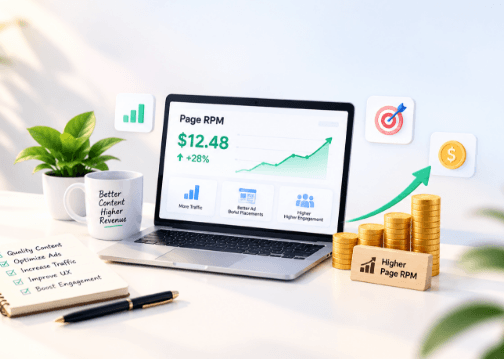
How to Increase Page RPM: 10 Strategies for Publisher
Page RPM is the number that tells you what a thousand page views are actually worth to you. Not per impression. Not per click. Per page view.
That distinction matters more than most publishers realize. For example, you can run perfect ads and still earn poorly if each page view only supports one weak ad slot. In short, Page RPM catches that problem where eCPM hides it.
This guide covers what Page RPM means, the metrics that drive it, and ten strategies that move it upward. Finally, you’ll find answers to the questions publishers ask most.
What Is Page RPM?
Page RPM stands for Revenue Per Mille, measured per thousand page views. Specifically, it tells you how much revenue you earn for every 1,000 pages a user loads on your site.
The formula is simple:
Page RPM = (Total Revenue ÷ Total Page Views) × 1,000
For example, say your site earned $600 last month across 200,000 page views.
Page RPM = ($600 ÷ 200,000) × 1,000 = $3.00
So every thousand page views brought in $3.
Now compare that to eCPM. eCPM measures revenue per thousand ad impressions, while Page RPM measures revenue per thousand page views. After all, one page view can hold three ad slots, or one, or none.
That gap is exactly where Page RPM earns its value. In fact, it captures both how well your ads perform and how well your pages use the traffic they receive.
Page RPM is also the clearest signal of overall site health. Overall, it folds together your ad rates, your fill rate, your layout, and your audience quality into one figure you can track week over week.
Here is why that matters in practice. Two publishers can report the same eCPM of $4. The first serves three viewable ads per page. Meanwhile, the second serves only one. As a result, their Page RPM will differ by roughly three times, even though the ad performance is identical.
This is also why chasing eCPM alone can mislead you. For instance, removing weak ad units often raises eCPM on paper, because your average improves once you drop the low earners. However, your total revenue may still fall, and Page RPM catches that immediately.
What Are the Metrics of Page RPM?
Page RPM does not move on its own. Instead, several underlying metrics push it up or drag it down. Once you understand them, you know exactly where to focus.
Total ad revenue. This is your numerator. Specifically, it includes display ads, video, native placements, affiliate income, and any other monetized element on the page.
Page views. This is your denominator. Surprisingly, more page views without more revenue actually lowers your RPM.
eCPM. Your effective cost per thousand impressions. Naturally, a higher eCPM lifts RPM directly, assuming your ad count stays steady.
Ad impressions per page. In other words, how many ad slots actually load on a single page view. For example, a page with four viewable slots earns more than a page with one.
Fill rate. The percentage of ad requests that return a live ad. Consequently, unfilled slots pull revenue down while page views stay the same.
Viewability. The share of your ads that users actually see. Since advertisers pay more for inventory that gets viewed, this metric matters directly.
Click-through rate. This matters most for CPC campaigns. Specifically, a higher CTR raises revenue on those placements.
Session depth and time on page. Similarly, longer sessions create more page views and more monetizable moments per user.
Traffic geography. Visitors from high-demand markets carry higher ad rates. Therefore, your traffic mix shifts your RPM meaningfully.
Device split. Mobile and desktop attract different demand and support different formats. As a result, your RPM reflects that balance.
Bounce rate. High bounce rates mean single-page sessions. Consequently, those sessions rarely reach your best-performing placements.
It helps to watch these together rather than alone. For instance, a rising eCPM alongside a falling fill rate can leave RPM flat overall. Only the combined view tells the real story.
10 Strategies to Increase Page RPM
1. Optimize Ad Placement Above the Fold
First, place at least one strong ad unit where users see it immediately. Above-the-fold placements earn higher viewability scores, and better viewability, in turn, attracts better bids.
That said, keep it balanced. An ad that pushes your content off the screen frustrates users, so aim for visible, not intrusive.
A good rule works like this. Users should see your headline and the opening lines of content without scrolling. Meanwhile, the ad sits alongside that, not in front of it.
2. Increase Viewable Ad Slots Per Page
Next, more viewable slots per page view raises RPM directly. For instance, you can add units at natural content breaks or use in-content placements between paragraphs.
However, do not simply stack more ads. Instead, each new unit should sit somewhere users actually look. In other words, three viewable slots beat six invisible ones.
3. Run Header Bidding or Mediation
A single ad network gives you a single pool of buyers. In contrast, header bidding lets multiple networks compete for the same impression at once.
That competition pushes prices up. As a result, publishers who switch from a basic waterfall to header bidding often see meaningful RPM gains.
Similarly, mediation helps on the app side. It routes unfilled requests to backup networks instead of leaving slots empty, so fewer empty slots means more revenue spread across the same page views.
4. Use High-Performing Ad Formats
Not all formats earn equally. For example, rewarded video, native ads, and sticky footer units typically outperform standard banners.
Therefore, test formats against each other on your own traffic. Since your results will differ from industry averages, let your data decide.
5. Improve Page Speed
Slow pages hurt in two ways. First, users leave before ads load. Second, ads that render late miss their chance to be seen entirely.
So, compress images, lazy-load ads below the fold, and trim unnecessary scripts. Ultimately, faster pages mean more completed impressions per page view.
Speed also affects session depth. For instance, users who wait three seconds for a page rarely click through to a second one. Every abandoned session, in turn, costs you the page views that would have followed.
6. Increase Session Depth With Internal Linking
Every additional page a user visits adds a monetizable page view. Therefore, strong internal linking keeps users moving through your site.
For example, place related-content modules at the end of articles and link contextually within your copy. Ultimately, make the next click obvious.
7. Target Higher-Value Traffic
Traffic quality shapes RPM more than almost anything else. For instance, organic search visitors typically outperform social traffic on RPM, and returning visitors often outperform first-timers.
So, focus your content strategy on topics that attract buyers, not just readers, since advertiser demand follows commercial intent.
Geography plays a role too. If your content can reasonably serve higher-demand markets, that shift lifts RPM without requiring any layout change at all.
8. Tune Your Price Floors Carefully
Floors protect you from underselling inventory. However, set them too high and you lose bids entirely, which empties slots and, ultimately, lowers RPM.
Instead, use dynamic floor pricing rather than one static number. Specifically, adjust by device, geography, and time of day, then review the data monthly.
9. Add Engagement and Gamification Elements
Engaged users stay longer and view more pages, so that alone raises RPM. Furthermore, engaged users also generate higher-quality impressions that advertisers bid harder for.
For example, interactive quizzes, rewarded actions, polls, and gamified experiences all extend sessions naturally. In other words, they give users a reason to keep going rather than forcing more ads into the same visit.
This approach compounds over time. Since users who enjoy the experience return more often, repeat visitors carry stronger engagement signals. Consequently, advertisers pay more for that audience.
10. Test and Iterate Continuously
Finally, run A/B tests on placement, density, and format. Change one variable at a time, and give each test enough traffic to produce a real signal.
Track results weekly, since RPM shifts with seasons, traffic mix, and advertiser budgets. What worked in Q1, for instance, may underperform in Q3. Therefore, continuous testing keeps you ahead of those shifts.
FAQs
What is a good Page RPM? It varies widely by niche, geography, and format. Still, many content sites land between $2 and $15. Finance, tech, and legal niches, for example, often run higher. In any case, compare against your own history rather than a benchmark.
What is the difference between Page RPM and eCPM? Page RPM measures revenue per thousand page views, while eCPM measures revenue per thousand ad impressions. Since one page view can carry several impressions, the two numbers rarely match.
Does adding more ads always increase RPM? No. In fact, extra ads can lower viewability, slow your pages, and push users away. Past a certain density, therefore, RPM falls instead of rising.
Why did my RPM drop even though traffic grew? Likely, traffic quality changed. For instance, a surge of low-intent or low-value-geography visitors adds page views without adding proportional revenue. As a result, RPM falls.
How often should I check Page RPM? Weekly works for most publishers. In addition, review monthly trends alongside it to separate real changes from normal fluctuation.
Does mobile traffic have lower RPM than desktop? Often, but not always. Mobile supports fewer ad slots per screen. That said, well-optimized mobile layouts with strong formats can close much of that gap.
Can affiliate revenue count toward Page RPM? Yes. Page RPM includes all revenue tied to your page views. However, many publishers track ad-only RPM and total RPM separately for clarity.
Do ad blockers affect Page RPM? Yes. Blocked requests still register as page views but generate no revenue. Consequently, a high blocker rate in your audience will hold RPM down.
How long should I run an RPM test before judging results? Give each test at least two weeks. Otherwise, shorter windows get distorted by daily traffic swings and weekend demand patterns.
Page RPM rewards publishers who think about the whole page, not just the ad slot. Therefore, improve your layout, speed, demand sources, and engagement together. Track the metric weekly, test one change at a time, and ultimately let the data guide where you push next.